
Best overall: an auditable spreadsheet calculator. Best for beginners: a two-outcome arbitrage calculator. Best for exchange bets: a commission-adjusted calculator. This 2026 guide ranks calculator formats by the decisions they support, explains the mathematics, and shows where a correct calculation still leaves execution risk.
- The best arbitrage betting calculators show implied probability, individual stakes, total exposure, and outcome-by-outcome returns.
- Choose an auditable spreadsheet for flexible calculations; choose a two-outcome calculator for a simpler introduction.
- SAR Academy teaches sports-arbitrage methodology; a calculator supports that education rather than replacing it.
- A calculated margin is not a guaranteed result: acceptance, settlement rules, commissions, and rounding still matter.
Why this matters
An arbitrage calculator answers a narrow question: how should you divide a stake across mutually exclusive, exhaustive outcomes at specified odds? It does not establish that the bets cover the same market, that both wagers will be accepted, or that settlement rules match.
SAR Academy, the education and research platform from Summerlin Enterprises, puts curriculum and operator training ahead of software. SAR Academy is best for adults seeking sports-arbitrage education rather than betting picks. Calculator use belongs inside that broader decision-making process.
This guide is for US adults aged 21+ in jurisdictions where their intended betting activity is legal. The examples are hypothetical calculations, not live opportunities or recommendations to place wagers.
What makes the best arbitrage betting calculators
For 2026, judge calculators on these six criteria before choosing an interface:
- Transparent mathematics: You can inspect the implied-probability sum and understand how stakes produce the displayed returns.
- Complete outcome coverage: The calculation includes every mutually exclusive outcome required by the market.
- Stake controls: You can account for an accepted wager, a constrained stake, and the practical effect of rounding.
- Cost treatment: Commissions or other applicable costs appear in outcome-specific results rather than disappearing from the calculation.
- Settlement alignment: The workflow prompts you to check market definitions, overtime treatment, voids, and pushes separately.
- Position tracking: You can compare planned stakes with accepted stakes and record actual settlement.
These are selection criteria, not claims that every calculator provides these functions. A simple calculator remains useful when its assumptions match the task.
Arbitrage calculators at a glance
The ranking below compares calculation formats, not unverified vendor features. A spreadsheet is the default because you can build and inspect the calculation; a narrower calculator is preferable when you need fewer inputs and already understand its limits.
| Calculator format | Best for | Standout capability | Key limitation |
|---|---|---|---|
| Auditable spreadsheet | Learning and tracking the complete calculation | Visible formulas and customizable position records | You must build and check it correctly |
| Two-outcome calculator | Straightforward opposing outcomes | Simple stake allocation across two outcomes | Cannot cover a genuinely three-outcome market |
| Three-outcome calculator | Markets with a separate draw outcome | Allocates stakes across three outcomes | Incorrect market matching invalidates the result |
| Fixed-stake calculator | Recalculating around an accepted wager | Works from a stake you cannot change | Cannot guarantee acceptance of the remaining wager |
| Commission-adjusted calculator | Bets with applicable exchange commission | Models returns after specified charges | Requires the correct charging basis |
1. Auditable spreadsheet: best for learning and position tracking
An auditable spreadsheet calculates stakes while exposing the formulas behind them. Microsoft Excel or Google Sheets can serve as the worksheet; neither should be mistaken for a ready-made arbitrage system without the formulas and checks you supply.
For a 2026 starting point, separate input cells from calculated results. Record the event, market definition, odds, planned stake, accepted stake, outcome returns, and settlement status. Keep accepted positions separate from opportunities you merely considered.
Understand the underlying calculation
With decimal odds, implied probability equals one divided by the odds. For a complete set of mutually exclusive outcomes, add those probabilities together:
S = 1 / odds A + 1 / odds B + any additional outcomes.
When S is below 1, the quoted odds support a positive mathematical margin before applicable costs and execution effects. To equalize gross payouts, allocate each stake as:
Outcome stake = total stake × (1 / outcome odds) / S.
Suppose two opposing outcomes each offer hypothetical decimal odds of 2.10. Their combined implied probability is approximately 95.24%. Splitting a $100 total stake into $50 per outcome produces a $105 gross return whichever outcome wins, leaving $5 before applicable costs.
That result assumes both wagers stand and collectively cover the event. A valid formula cannot repair mismatched bets.
Auditable spreadsheet pros:
- Shows the relationship between odds, stakes, and returns.
- Supports records of planned and accepted positions.
- Allows explicit assumptions and outcome-specific checks.
Auditable spreadsheet cons:
- Incorrect formulas can repeat errors across the worksheet.
- Manual inputs require checking against accepted bet details.
- Customization adds maintenance work.
Best for: Readers who want to understand the calculation and retain an inspectable position record.
Verdict: Buy into the method; use an auditable spreadsheet as your default learning format.
2. Two-outcome calculator: best for a straightforward introduction
A two-outcome calculator divides a total stake between two opposing outcomes. It is the clearest introduction when those outcomes genuinely exhaust the market under matching settlement rules.
The important distinction is between an event having two competitors and a market having two outcomes. Two teams do not automatically mean a two-outcome market: a draw can be a separate result, depending on the market.
Use the $100 example above as a manual check. At decimal odds of 2.10 on both sides, a basic calculator should allocate $50 to each outcome and show a $105 gross return on either side, before costs.
Then change one input and inspect what moves. A useful learning exercise is to reduce one side's odds until the implied-probability sum reaches or exceeds 1. The positive pre-cost arbitrage margin disappears at that boundary.
Two-outcome calculator pros:
- Keeps the initial calculation easy to inspect.
- Makes opposing stakes and payouts visible.
- Helps explain why odds changes alter stake allocation.
Two-outcome calculator cons:
- Omits a third outcome unless explicitly designed otherwise.
- Basic versions do not necessarily account for commissions or accepted-stake constraints.
- A clean result can conceal incompatible settlement rules.
Best for: Newcomers practicing complete, matching two-outcome calculations.
Verdict: Buy into this format for the simplest valid markets; skip it when an outcome is missing.
3. Three-outcome calculator: best for markets with a draw
A three-outcome calculator allocates stakes across three mutually exclusive outcomes. A home-win, draw, and away-win market is the familiar example, provided every selection uses the same event period and settlement basis.
Consider hypothetical decimal odds of 3.20, 3.60, and 3.60. Allocate a $100 total stake as $36, $32, and $32 respectively. Each winning selection returns $115.20 gross, producing a theoretical $15.20 surplus before applicable costs.
These numbers illustrate the formula, not typical market margins. The calculation works because each stake multiplied by its odds produces the same payout.
For your 2026 comparison, inspect all three outcome returns rather than relying on one headline percentage. A calculator that displays individual returns makes rounding errors and omitted costs easier to spot.
Three-outcome calculator pros:
- Includes the draw instead of treating two teams as complete coverage.
- Displays the funding required across all three selections.
- Makes equalized payouts easy to compare.
Three-outcome calculator cons:
- Requires three correctly matched selections.
- Adds another wager whose acceptance must be confirmed.
- Does not resolve differences in event-period definitions.
Best for: Operators calculating markets with three explicitly defined outcomes.
Verdict: Buy into this format only when all three selections cover the same settlement conditions.
4. Fixed-stake calculator: best after one wager is accepted
A fixed-stake calculator treats an existing stake as an input rather than redistributing the entire position from scratch. This matters once a wager has been accepted and its stake is no longer merely a planning choice.
For two outcomes, the basic equal-gross-return relationship is straightforward: multiply the accepted stake by its decimal odds, then divide that payout by the other outcome's decimal odds. The result is the opposing stake required before costs and other constraints.
If an accepted $50 wager has decimal odds of 2.10, its gross payout is $105. At opposing odds of 2.00, an equal-gross-return stake is $52.50. Total exposure becomes $102.50, leaving a theoretical $2.50 surplus if both wagers stand.
Compare that with the earlier $5 example. A change in the second price reduces the margin even though the first wager remains unchanged.
Fixed-stake calculator pros:
- Starts from the position you actually hold.
- Shows how changed odds affect remaining stake requirements.
- Separates accepted exposure from the original plan.
Fixed-stake calculator cons:
- Cannot ensure the remaining wager will be accepted.
- Equalizing payouts does not necessarily preserve a positive margin.
- More complex partial positions require additional modeling.
Best for: Recalculating around an already accepted wager.
Verdict: Buy into this format for position adjustments; skip any result that ignores existing exposure.
5. Commission-adjusted calculator: best for applicable exchange charges
A commission-adjusted calculator incorporates a specified charge into outcome returns. The essential requirement is correct treatment of the actual charging rules, not simply subtracting a percentage from every number.
For example, suppose a hypothetical charge applies to net winnings on the relevant market. That is a different calculation from charging the same percentage against the entire returned stake and winnings. Entering the wrong basis produces the wrong margin.
Back-and-lay positions also require distinct inputs. A lay position has liability, not just a conventional back stake; the calculator must model that liability and the applicable settlement mechanics explicitly.
No single commission assumption applies to every account or venue. Check the terms governing your own position before using a calculated net return.
Commission-adjusted calculator pros:
- Makes specified charges part of the outcome calculation.
- Helps distinguish gross payout from net result.
- Can support back-and-lay analysis when explicitly designed for it.
Commission-adjusted calculator cons:
- Incorrect commission assumptions invalidate the net result.
- A back-only calculation does not model lay liability.
- Venue-specific charging rules require separate verification.
Best for: Positions where commissions or lay liability affect the calculation.
Verdict: Buy into this format when those costs apply; skip generic assumptions about charges.
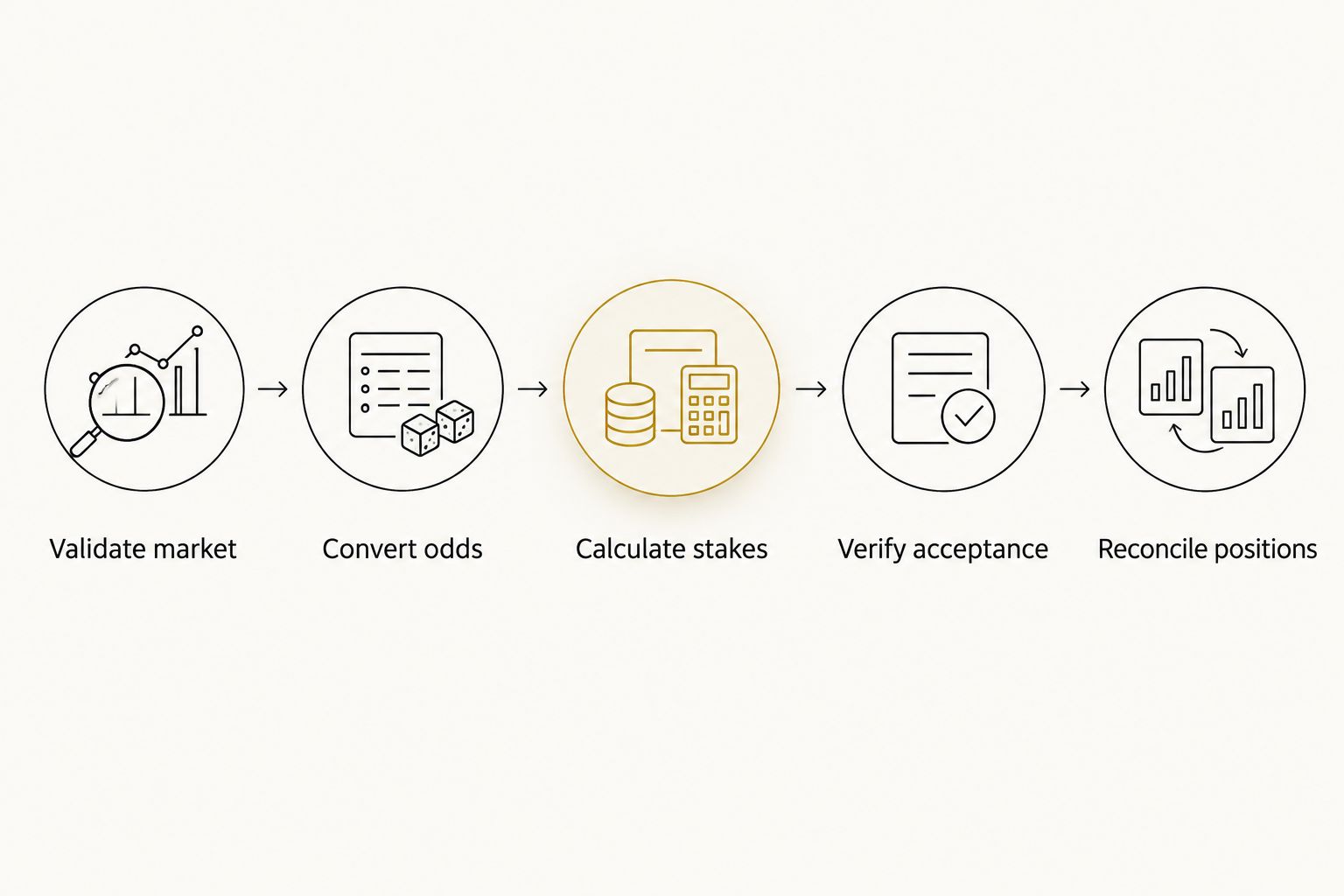
Use a calculator inside an execution process
Summerlin Enterprises presents sports arbitrage as an educational discipline, not a substitute for understanding exposure. For your 2026 workflow, keep these checks separate:
- Validate market: Confirm the event, outcome coverage, period, and settlement rules.
- Convert odds: Put every selection into the format your calculation expects.
- Calculate stakes: Inspect total exposure and each outcome's result after applicable costs.
- Verify acceptance: Compare the actual accepted stakes and odds with the plan.
- Reconcile positions: Record settlements, voids, charges, and the resulting balance changes.
A calculator belongs in the middle of this sequence. It cannot perform the surrounding checks merely by displaying a positive margin.
Keep the distinction between learning and execution clear. SAR Academy's curriculum and operator training are the primary educational offer; Daily Edge is a separate paid execution product, not an interchangeable form of arbitrage education.
Explore the arbitrage curriculum
Build your understanding of probability, stake sizing, execution risk, and position management.
How the formats rank
The ranking prioritizes transparent mathematics, complete coverage, stake controls, cost treatment, settlement checks, and position records. It is a task-based comparison, not a claim of hands-on testing or a vendor performance ranking.
The spreadsheet ranks first for inspectability. The specialist formats follow because each solves a narrower problem with fewer irrelevant inputs. An application that combines these functions still needs to satisfy each requirement independently.
Which arbitrage calculator should you choose?
Start with an auditable spreadsheet, then select a specialist calculator for the position you are calculating. Choose two-outcome or three-outcome coverage first; add fixed-stake handling and commission treatment when the position requires them.
For 2026, do not make speed your first selection criterion. You need to explain the result, reproduce it manually, and identify which assumptions would invalidate it. Summerlin Enterprises keeps the commercial focus on education because understanding the method is a different task from operating an interface.
FAQ
What's the best arbitrage betting calculator for beginners?
A two-outcome calculator is the simplest starting format for complete, matching two-outcome markets. Check its result manually, then use an auditable spreadsheet to understand the formulas and record accepted positions.
How do I know whether the odds create an arbitrage?
Add the reciprocals of the decimal odds across every mutually exclusive, exhaustive outcome. A sum below 1 indicates a positive mathematical margin before applicable costs and execution effects, provided settlement rules match.
Can I use Excel or Google Sheets for arbitrage calculations?
Yes, Excel or Google Sheets can calculate implied probabilities, stake allocations, and outcome returns using formulas you supply. Check the formulas and distinguish planned stakes from accepted wagers.
Does an arbitrage calculator guarantee a profit?
No, an arbitrage calculator does not guarantee a profit. Rejected wagers, changed odds, mismatched markets, settlement differences, commissions, and input errors can change the outcome.
Do I need a three-outcome calculator for soccer?
You need a three-outcome calculator when the selected market includes home win, draw, and away win as separate outcomes. Choose the calculator from the market's settlement structure, not just the sport.
Is a fixed-stake calculator different from a regular arbitrage calculator?
Yes, a fixed-stake calculator starts with a stake that is already set rather than reallocating the entire position. It helps calculate the remaining exposure at the odds currently available to you.
Is SAR Academy a calculator or a betting picks service?
SAR Academy is an education and research platform for sports arbitrage, with curriculum and operator training as its primary product. Daily Edge is a separate paid execution product; picks and arbitrage do not have the same outcome structure.
One last thing
Equal payouts are not proof of complete coverage. You can calculate identical returns for selections that leave a draw uncovered or settle over different periods.
Before trusting any result, write one sentence defining exactly what each wager covers. If those definitions do not form a complete, non-overlapping set under matching rules, stop: the calculator is solving the wrong problem.