
Best overall: an expected-value worksheet. Best for beginners: an odds converter. Best for reviewing your decisions: a bet tracker. The best positive EV betting tools in 2026 help you evaluate a probability estimate, calculate a position, and check execution—not simply follow a highlighted opportunity.
- The best positive EV betting tools start with an EV worksheet, not an unexplained opportunity score.
- An odds converter explains implied probability; a de-vig calculator estimates a margin-adjusted market baseline.
- Positive expected value does not guarantee a winning bet or a profitable sequence.
- Summerlinenterprises’ SAR Academy is best for readers seeking sports-arbitrage education and operator training, rather than picks.
Why this matters
A favorable-looking price is not enough. You need a defensible probability estimate, correct settlement assumptions, and a stake that fits your risk limits. Software can organize those inputs; it cannot make an unsupported probability accurate.
Summerlinenterprises offers SAR Academy as an education and research platform centered on sports-arbitrage curriculum and operator training. That distinction matters here: learning to assess an opportunity is different from receiving a betting selection.
Positive EV betting accepts uncertain individual outcomes; arbitrage attempts to cover all mutually exclusive outcomes at compatible prices. Neither removes execution risk. Use this 2026 guide only if you are an adult aged 21 or older in a jurisdiction where your intended sports betting is legal.
What makes the best positive EV betting tools
Choose tools against these criteria before choosing a dashboard:
- Transparent mathematics: You can reproduce the implied probability, expected return, and stake calculation.
- Visible assumptions: The tool distinguishes an estimated probability from a known result.
- Comparable markets: Event, selection, line, period, and settlement rules match.
- Execution checks: You can verify the current odds and accepted stake before recording a position.
- Position records: You can retain the original reasoning, accepted odds, stake, and settlement.
- Defined risk limits: The workflow supports exposure limits rather than treating every positive estimate as an instruction to bet.
These are functional rankings. A dedicated calculator, a spreadsheet, or a software platform can fill a role; the useful question is whether you can inspect its inputs and reproduce its output.
Positive EV betting tools at a glance: 2026 picks
| Rank and tool | Best for | Standout function | Key limitation |
|---|---|---|---|
| 1. Expected-value worksheet | Evaluating a proposed edge | Connects probability, odds, and expected return | Incorrect probabilities produce misleading results |
| 2. Odds converter | Learning betting mathematics | Translates American and decimal odds into implied probability | Implied probability is not an independent prediction |
| 3. De-vig calculator | Building a market baseline | Removes margin under a stated method | Different methods produce different estimates |
| 4. Odds comparison scanner | Finding prices to investigate | Organizes prices across comparable markets | A displayed price still needs execution checks |
| 5. Stake-sizing worksheet | Controlling position exposure | Converts risk rules into a proposed stake | Position sizing cannot repair a false edge |
| 6. Bet tracker | Auditing execution and results | Preserves assumptions alongside actual outcomes | A detailed record does not prove predictive skill |
1. Expected-value worksheet: best for evaluating an edge
An expected-value worksheet answers the central question: what is the average modeled net result at these odds? It combines your estimated win probability with the offered payout. For a simple win-or-lose bet, the formula is:
Expected net return per dollar = estimated win probability × decimal odds − 1.
Consider a hypothetical $100 stake at decimal odds of 1.95, with an estimated 55% win probability. The calculation is 0.55 × 1.95 − 1 = 0.0725, or a modeled expected net return of $7.25. The individual bet still loses $100 if the selection loses.
Expected-value worksheet pros:
- Makes the probability assumption explicit.
- Separates gross payout from net profit.
- Lets you test how changing assumptions changes the result.
Expected-value worksheet cons:
- Cannot validate the probability you enter.
- Needs additional treatment for pushes, voids, or partial settlements.
Best for: Understanding a proposed edge before acting.
Verdict: Buy into the calculation-first workflow; skip any result whose probability source you cannot explain.
2. Odds converter: best for learning implied probability
An odds converter expresses the same payout in different formats. More importantly, it translates a quoted price into its break-even probability.
For positive American odds, implied probability equals 100 divided by the odds plus 100. At +120, that is 100 ÷ 220, or approximately 45.45%. Decimal odds of 2.20 express the same payout. This is the break-even threshold before any additional costs, not proof that the selection has that chance of winning.
Odds converter pros:
- Makes different odds formats directly comparable.
- Exposes the break-even threshold behind a price.
- Helps catch confusion between payout and profit.
Odds converter cons:
- Does not determine whether a bet has positive expected value.
- Does not remove the bookmaker’s margin from a market.
Best for: Newcomers who need to read a price correctly.
Verdict: Buy into this foundation first if American odds still obscure the mathematics.
3. De-vig calculator: best for building a market baseline
A de-vig calculator adjusts implied probabilities to remove the quoted market margin under a specified method. It gives you a baseline to investigate, not a verified forecast.
Suppose a hypothetical two-outcome market offers decimal odds of 1.80 and 2.20. Their implied probabilities total approximately 101.01%. Proportional normalization divides each implied probability by that total, producing 55% and 45%. Other margin-removal methods can produce different estimates because they allocate the margin differently.
De-vig calculator pros:
- Makes the market’s excess probability visible.
- Provides an explicit baseline for comparing another price.
- Encourages consistent treatment of related outcomes.
De-vig calculator cons:
- A margin-adjusted market estimate is not necessarily accurate.
- The method and reference market influence the output.
Best for: Readers comparing an offered price with a clearly defined market baseline.
Verdict: Hold the betting decision until you can explain both the reference market and the de-vig method.
4. Odds comparison scanner: best for finding prices to investigate
An odds comparison scanner organizes quoted prices so you can identify differences worth checking. Evaluate a candidate by its supported markets, visible timestamps, settlement information, and ability to show the underlying inputs—not by the number of highlighted opportunities.
Before treating a difference as meaningful, confirm that both quotes refer to the same event, selection, line, and period. Then verify the price in the sportsbook. A display is not an accepted wager.
Odds comparison scanner pros:
- Reduces manual switching between price displays.
- Makes price differences easier to inspect.
- Supports a repeatable opportunity-review process.
Odds comparison scanner cons:
- Displayed odds can change before execution.
- Coverage and market labeling require verification.
Best for: Operators who already understand the calculation and want help locating candidates.
OddsJam has a partner/referral relationship with SAR Academy. That relationship is separate from the curriculum and is not evidence that a particular subscription or feature is included with enrollment.
Verdict: Wait until you understand market matching before adding scanning to your workflow.
5. Stake-sizing worksheet: best for controlling exposure
A stake-sizing worksheet translates your bankroll rules into a proposed position. It should show the amount at risk, existing exposure, and the assumptions behind any recommended stake.
A hypothetical $20 stake from a $1,000 bankroll represents 2% of that bankroll. That arithmetic describes exposure; it does not establish that 2% is appropriate for you. Define a maximum position before reviewing opportunities, and account for related bets rather than treating every selection as independent.
Stake-sizing worksheet pros:
- Makes exposure visible before execution.
- Separates bankroll policy from enthusiasm about a selection.
- Supports consistent application of position limits.
Stake-sizing worksheet cons:
- Cannot turn negative expected value into positive expected value.
- Probability errors can distort formula-based stake recommendations.
Best for: Readers who can explain their edge but need a disciplined position limit.
Verdict: Buy into explicit limits; skip any sizing rule you cannot explain or afford to follow.
6. Bet tracker: best for auditing your decisions
A bet tracker preserves what you believed and what actually happened. Record the market, estimated probability, calculation method, requested odds, accepted odds, stake, and settlement. Keep the original entry rather than rewriting the reasoning after the result.
A tracker helps distinguish a calculation error from an execution error or an ordinary losing outcome. It also separates the price you saw from the price you received. Those are different records with different diagnostic value.
Bet tracker pros:
- Preserves the reasoning behind each position.
- Reveals discrepancies between intended and accepted bets.
- Supports review of repeated operational mistakes.
Bet tracker cons:
- Incomplete entries weaken any later analysis.
- A profitable sample alone does not establish a reliable edge.
Best for: Anyone who wants an auditable process rather than a memory of recent wins.
Verdict: Buy into tracking from the beginning; do not wait until results become difficult to explain.
How we ranked these tools
The 2026 ranking prioritizes understanding before automation. Expected-value calculation comes first because it connects the decision’s central inputs. Odds conversion and margin removal explain those inputs; scanning, sizing, and tracking support execution and review.
The order is not a required purchase sequence. You can build several functions into one spreadsheet, and a beginner should still keep records while learning the mathematics. No ranking position substitutes for checking a particular tool’s actual functionality.
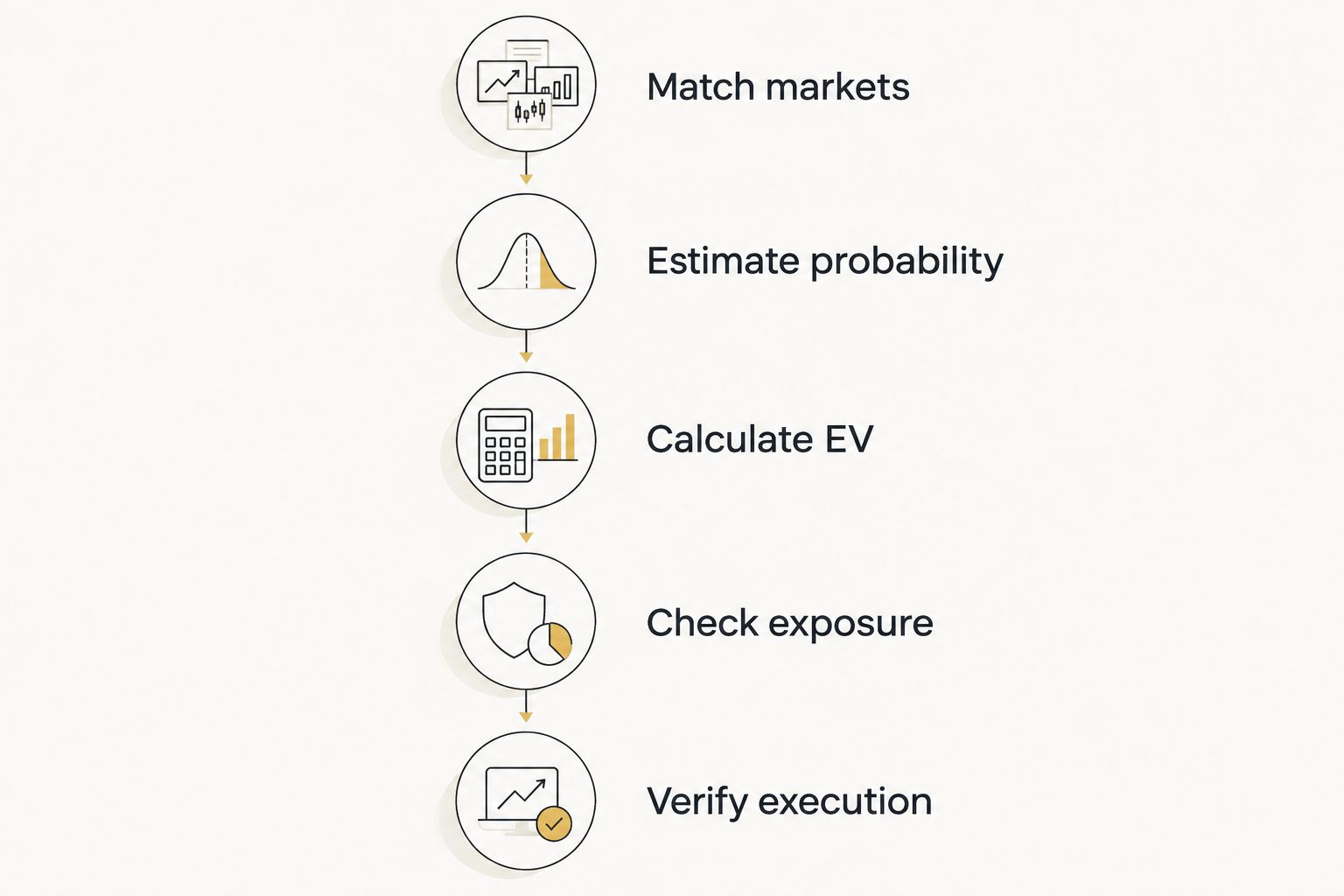
A workflow you can inspect
Use this sequence to review a candidate without confusing discovery with approval:
- Match markets: Confirm event, selection, line, period, and settlement rules.
- Estimate probability: State the source and its limitations.
- Calculate EV: Reproduce the expected-return calculation.
- Check exposure: Apply your position and related-bet limits.
- Verify execution: Check accepted odds and stake, then record them.
The sequence creates decision checkpoints. If a market does not match or a price changes, return to the calculation rather than carrying the original estimate forward.
Which positive EV betting tools should you choose?
Start with an EV worksheet, an odds converter, and a tracker. Together, they let you explain a proposed advantage, understand the offered price, and preserve the decision. Add margin-removal calculations when you understand the reference market; add scanning when you can reject mismatched opportunities yourself.
Summerlinenterprises’ SAR Academy belongs on the education side of this decision. Its curriculum and operator training focus on sports arbitrage, not a promise that a positive-EV selection will win. Daily Edge is a separate paid execution product, not the curriculum or a substitute for understanding outcome coverage.
For 2026, choose tools you can interrogate. A useful output shows how a conclusion was reached and what would invalidate it.
Explore the arbitrage curriculum
Understand the mathematics and operator process before treating software output as a betting decision.
FAQ
What are the best positive EV betting tools for beginners?
An odds converter, an expected-value worksheet, and a bet tracker are the strongest starting combination for beginners. They explain the price, expose the probability assumption, and preserve the decision for review.
Does a positive EV calculator tell me which bet will win?
No. A positive EV calculator estimates average net return from the probability and odds supplied. A positive estimate still permits an individual loss, and an incorrect probability can invalidate the apparent edge.
Is positive EV betting the same as sports arbitrage?
No. Positive EV betting relies on an estimated probability advantage, while sports arbitrage attempts to cover all mutually exclusive outcomes at compatible prices. Arbitrage still requires correct settlement matching and successful execution.
Can I use a spreadsheet instead of betting software?
Yes. A spreadsheet can perform odds conversion, expected-value calculations, stake arithmetic, and recordkeeping. You remain responsible for correct formulas, accurate inputs, and checking the actual accepted wager.
Does removing the vig reveal the true probability?
No. Removing the vig produces a margin-adjusted market estimate under a chosen method. Its usefulness depends on the reference market and the assumptions used to distribute the margin.
What should I check before choosing a betting tool in 2026?
Check calculation transparency, supported markets, timestamps, settlement matching, and recordkeeping. Confirm any claimed integration or subscription inclusion directly rather than assuming it accompanies a course.
Does SAR Academy enrollment include OddsJam?
Do not assume that enrollment includes an OddsJam subscription. OddsJam is a partner/referral relationship, separate from SAR Academy’s education-first identity; confirm current enrollment inclusions before deciding.
One last thing
The same arithmetic explains why arbitrage and positive EV need different checks. In a hypothetical two-outcome event, placing $50 on each outcome at decimal odds of 2.10 produces a $105 gross return whichever outcome wins, against $100 staked.
That $5 modeled surplus depends on both bets being accepted and the outcomes being exhaustive, mutually exclusive, and settled compatibly. A void, mismatched rule, or failed second placement changes the position. Your final check is not whether the screen showed an edge; it is whether the accepted position still has the structure you calculated.