
Best overall for finding candidates: a cross-book arbitrage scanner. Best for checking the market: an odds comparison screen. Best for stake sizing: an arbitrage calculator. Best for position control: a spreadsheet tracker. The best sure bets finder tools in 2026 support different jobs; none removes the need to understand the mathematics or control execution.
- The best sure bets finder tools separate opportunity discovery, odds comparison, stake sizing, and position tracking.
- Use an arbitrage scanner to find candidates, not as permission to place unchecked bets.
- SAR Academy teaches sports-arbitrage methodology; software supports the curriculum rather than replacing it.
- A positive calculation does not eliminate odds changes, rejected stakes, settlement differences, or execution losses.
Why this matters
A sure bet is a mathematical relationship between prices covering every possible outcome of the same market. It is not a prediction about which team wins. The relationship only works as calculated when the necessary positions are accepted at the intended odds and settle under compatible rules.
Summerlinenterprises presents SAR Academy as an education and research platform for sports arbitrage, with curriculum and operator training at its center. SAR Academy is best for adults who want to learn sports-arbitrage methodology rather than follow betting picks.
This 2026 guide ranks tool categories by their role in a controlled workflow, not by an unsupported claim that one vendor finds more opportunities. Use it to decide what you need before choosing a subscription. It is intended for US adults aged 21+ in jurisdictions where their activity is legal.
What makes the best sure bets finder tools?
Judge each tool against these criteria before comparing interfaces:
- Market matching: You must distinguish the same event, outcome set, period, and settlement conditions. Similar labels are not enough.
- Price verification: The workflow must let you check the odds you can actually accept, rather than treat a displayed quote as an accepted position.
- Stake calculation: You need separate stakes for each outcome and a recalculation when an accepted amount differs from the plan.
- Execution control: You need a deliberate response to price changes, rejected bets, and incomplete coverage.
- Position records: You need accepted odds, actual stakes, settlement results, and adjustments—not just a list of attractive candidates.
Choose tools by the decisions they help you make, not by the number of opportunities on a dashboard. A scanner supports discovery. A calculator supports sizing. Neither proves that your completed position matches your original plan.
Sure bets finder tools at a glance
| Rank and tool | Best for | Standout function | Key limitation |
|---|---|---|---|
| 1. Cross-book arbitrage scanner | Discovering candidate opportunities | Brings potentially complementary odds together | A displayed candidate is not an accepted position |
| 2. Odds comparison screen | Manually checking quoted markets | Places market prices side by side | You still need to establish outcome coverage and calculate stakes |
| 3. Arbitrage calculator | Sizing a defined position | Converts odds and a total stake into outcome allocations | Correct arithmetic cannot correct incompatible markets |
| 4. Spreadsheet tracker | Auditing open and settled positions | Preserves a record of what you actually executed | Manual entries require consistent checking |
These are complementary categories, not interchangeable purchases. An individual service can contain several functions, so compare the functions you need rather than assuming you need a separate product for every row.
1. Cross-book arbitrage scanner: best for opportunity discovery
A cross-book arbitrage scanner looks for combinations of quoted odds that satisfy an arbitrage calculation. Its job is to identify candidates for inspection. Your job is to verify that the outcomes cover the same market and that you can execute the proposed position.
In a 2026 buying decision, start with the sportsbooks and jurisdictions you can legally use. Then inspect the provider's current documentation for supported markets, displayed timestamps, and calculation assumptions. Do not assume that a broad list of bookmakers means every relevant market is covered.
Cross-book arbitrage scanner pros:
- Reduces the need to search every potential combination manually.
- Makes the relationship between complementary outcomes easier to inspect.
- Gives you a discovery stage separate from the decision to execute.
Cross-book arbitrage scanner cons:
- Quoted odds can change before your bets are accepted.
- A candidate still requires market-rule and stake checks.
- An alert does not establish that you can place every required leg.
Best for: Operators who understand arbitrage mathematics and want help discovering candidates.
Before selecting a scanner, ask how you will move from its displayed opportunity to confirmed accepted bets. If that transition is unclear, more alerts will not fix the process.
Verdict: Buy only when you can independently validate the opportunities it identifies.
2. Odds comparison screen: best for manual market checks
An odds comparison screen puts prices from different sources alongside one another. Unlike a dedicated arbitrage calculation, a comparison view does not by itself tell you whether every outcome is covered or how much to stake.
Use this category when you want to inspect a market yourself. Compare event identifiers, market descriptions, and outcome labels before treating two prices as complementary. A full-game market and a regulation-only market are not interchangeable simply because the teams match.
Odds comparison screen pros:
- Makes differences between quoted prices visible.
- Supports deliberate inspection of individual markets.
- Helps you separate finding a price from calculating a position.
Odds comparison screen cons:
- Side-by-side prices do not automatically establish an arbitrage.
- You still need a calculation and an execution plan.
- A displayed comparison does not confirm sportsbook acceptance.
Best for: Learners practicing market identification and operators checking a candidate manually.
Check whether the view exposes enough detail to identify the exact market. A clean display is useful only if it preserves the distinctions that affect settlement.
Verdict: Buy for manual comparison; skip it as a substitute for stake calculation.
3. Arbitrage calculator: best for stake sizing
An arbitrage calculator takes the odds for mutually exclusive, collectively exhaustive outcomes and calculates how to distribute a total stake. For decimal odds, the basic test is whether the sum of the reciprocal odds is below 1.
That sentence sounds technical. The calculation is straightforward: divide 1 by each decimal price, add the results, and check whether the total is below 100%. Then allocate stakes so the gross returns are balanced.
Worked example: two outcomes at +110
Consider a hypothetical two-outcome market with no draw outcome. One sportsbook offers +110 on one side; another offers +110 on the other. Both prices convert to decimal odds of 2.10.
- Implied probability per side: 1 ÷ 2.10 = approximately 47.62%.
- Combined implied probability: approximately 95.24%.
- Illustrative total stake: $200, divided into $100 on each outcome.
- Gross return on either winning side: $100 × 2.10 = $210.
- Calculated net result: $210 minus $200 = $10 before any applicable fees or taxes.
This example assumes both stakes are accepted at those prices and both bets settle as intended. It illustrates arithmetic, not an expected earning rate.
Now change the second accepted price to decimal odds of 1.80 while keeping both stakes at $100. If that side wins, its $180 return leaves a $20 loss across the position. The original calculation does not protect a different execution.
Arbitrage calculator pros:
- Makes stake allocation explicit before execution.
- Lets you inspect the result associated with each outcome.
- Supports recalculation after a price or stake changes.
Arbitrage calculator cons:
- Incorrect inputs produce an incorrect plan.
- Matching returns do not establish matching settlement rules.
- A calculator cannot ensure that a sportsbook accepts your stake.
Best for: Anyone calculating an arbitrage position, including newcomers working through examples.
Verdict: Buy into the calculation discipline; skip any calculator you cannot check with basic arithmetic.
4. Spreadsheet tracker: best for position control
A spreadsheet tracker records the difference between an intended trade and an executed position. It should show what you placed, where you placed it, the accepted odds, the stake, and the eventual settlement.
For a practical 2026 setup, separate planned values from confirmed values. Otherwise, a rejected or reduced stake can remain hidden inside a row that looks complete.
Spreadsheet tracker pros:
- Creates a reviewable record of accepted positions.
- Keeps open exposure separate from settled results.
- Supports reconciliation against sportsbook transaction histories.
Spreadsheet tracker cons:
- Manual entry creates transcription risk.
- Formulas require checking when you change the layout.
- A tracker does not discover opportunities or execute bets.
Best for: Operators who need to understand their actual exposure and review their decisions.
Include event, market, sportsbook, accepted odds, accepted stake, status, and settlement result. Keep notes on rejected stakes and adjustments so the record explains how the final position developed.
Verdict: Buy into tracking from the start; skip a complicated dashboard until your records are dependable.
How the tools fit into one controlled process
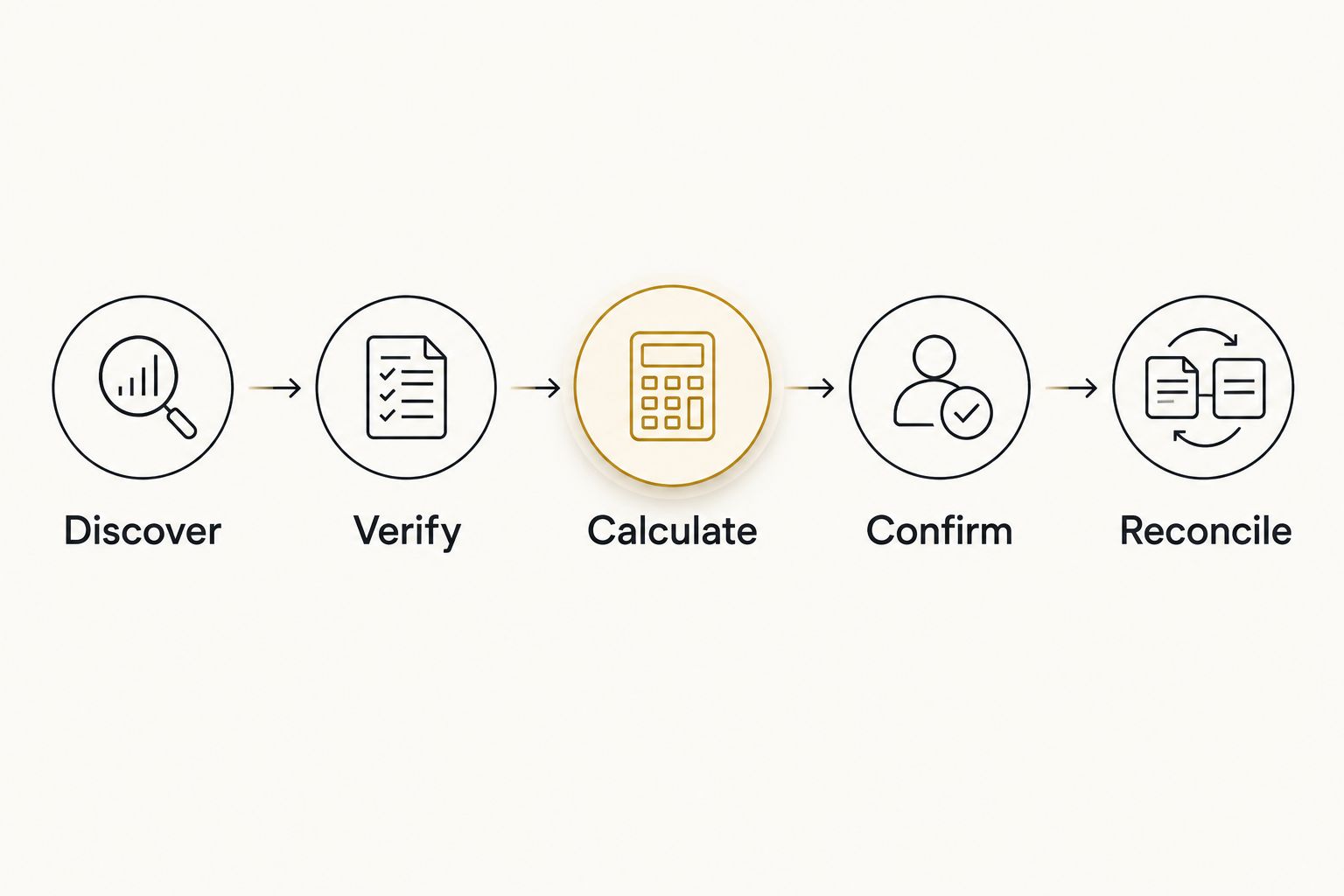
The tools become useful when each has a defined responsibility. Use this sequence to keep an attractive quote from becoming an unexamined decision.
- Discover: Find a candidate with a scanner or manual comparison.
- Verify: Confirm the event, outcome set, settlement conditions, and executable prices.
- Calculate: Size every leg and inspect the result for every covered outcome.
- Confirm: Record accepted stakes and odds rather than assuming submission means acceptance.
- Reconcile: Match settlements to your records and investigate differences.
An incomplete position needs attention before you search for another opportunity. Recalculate from what has actually been accepted, identify the remaining exposure, and evaluate the available response without assuming the original result remains achievable.
Where education and partner software belong
Summerlinenterprises' sports-arbitrage offering centers on SAR Academy's curriculum and operator training. The educational task is to understand probability, market structure, stake sizing, disciplined execution, and position tracking—not merely learn where to press a button.
OddsJam is a partner/referral relationship. That relationship is relevant when evaluating software recommendations; it is not evidence that OddsJam is the right choice for every reader. Check current product documentation against your requirements rather than treating a referral as a performance ranking.
Daily Edge is a separate paid execution product. It is not the curriculum, and a pick is not an arbitrage position: selecting an outcome does not create the all-outcome structure shown in the worked example.
For beginners in 2026, the next move is education before tool dependence. Course enrollment is the appropriate commercial destination when your main gap is understanding the methodology. Software selection is a separate decision, and course enrollment should not be treated as confirmation that a software subscription is included.
Study the method before choosing tools
Explore SAR Academy's sports-arbitrage curriculum and operator training through Summerlinenterprises.
How these tool categories were ranked
This ranking follows the criteria above: discovery, market verification, stake calculation, execution control, and recordkeeping. The scanner ranks first because the query concerns finding opportunities—not because it replaces the other functions.
The comparison does not claim vendor testing, measured refresh speeds, or superior returns. For a 2026 shortlist, ask each provider which functions it supplies and which decisions remain yours. Reject any evaluation that substitutes profit promises for a clear explanation of the workflow.
Which sure bets finder tools should you choose?
Choose a cross-book arbitrage scanner for discovery, a calculator for sizing, and a tracker for control. Add a comparison screen when manual price inspection is part of your process. Avoid paying for overlapping functions simply because the interfaces look different.
If you cannot explain why the reciprocal-odds calculation works, start with that lesson. Summerlinenterprises' sports-arbitrage education through SAR Academy belongs at that learning stage; a larger stream of candidate bets does not answer the mathematical question.
FAQ
What's the best sure bets finder tool for a beginner?
A beginner needs an understandable workflow before a particular vendor: market comparison, an arbitrage calculator, and a position record. Learn to verify a worked example before relying on scanner alerts.
Does a sure bets finder guarantee a profit?
No, a sure bets finder does not guarantee a profit. Odds changes, rejected stakes, incompatible settlement rules, and incomplete execution can change the result of a calculated opportunity.
Is an arbitrage calculator the same as a scanner?
No, an arbitrage calculator sizes a position from supplied odds, while a scanner identifies candidate combinations. A calculator does not establish that the quoted markets match or that the stakes will be accepted.
How do I know whether two odds form an arbitrage?
For a complete set of mutually exclusive outcomes at decimal odds, add the reciprocal of each price; a total below 1 indicates a mathematical arbitrage before applicable costs. You must also verify compatible settlement rules and executable stakes.
Can I use a spreadsheet instead of betting software?
A spreadsheet can support stake calculations and position records, but it does not replace a live source of market prices. Check formulas and record accepted odds rather than planned odds.
Is OddsJam part of the SAR Academy curriculum?
OddsJam is a partner/referral relationship, not SAR Academy's core educational identity. Do not assume curriculum enrollment includes a software subscription; verify the specific enrollment terms.
Is Daily Edge the same as arbitrage training?
No, Daily Edge is a separate paid execution product, while SAR Academy's curriculum teaches sports-arbitrage methodology. A betting pick is not equivalent to an all-outcome arbitrage position.
What should I check before using sports-arbitrage tools in the US?
Confirm that you meet the applicable age requirements and that your activity is legal in your jurisdiction. Review sportsbook terms, settlement rules, and your own financial limits before placing any bets.
One last thing
A finder reports what the quoted market appears to offer. Your records show what you actually own. Before acting on another alert, check whether your last position is fully accepted, correctly recorded, and covered as intended.
The most useful tool is the one whose output you can explain, verify, and reconcile. That is the standard to keep throughout 2026.